


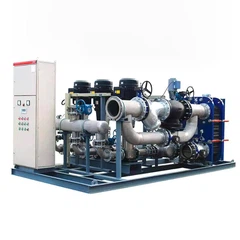
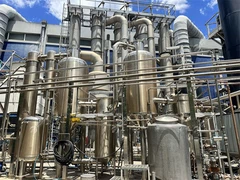
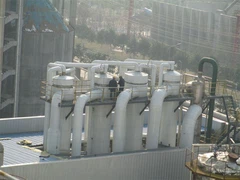
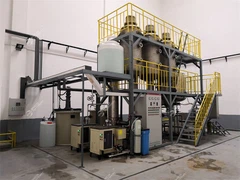
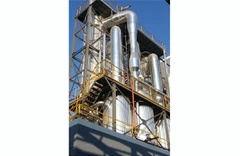
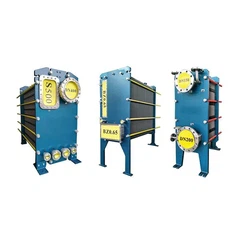






Falling Film Evaporator
Working Principle of Falling Film Evaporator
The falling film evaporator utilizes gravity-driven thin-film flow and external heat to efficiently concentrate solutions, especially for heat-sensitive or viscous materials.


Step-by-Step Breakdown
1. Liquid Distribution
● The feed liquid is uniformly distributed at the top of vertical heating tubes through specialized distributors (e.g., spray nozzles or perforated plates). This ensures a thin, continuous liquid film forms on the inner walls of the tubes.
2. Thin-Film Flow & Evaporation
● The liquid film flows downward along the heated tube walls.
● External heating media (e.g., steam) outside the tubes transfer heat to the liquid film, causing partial evaporation of the solvent (e.g., water).
3. Vapor-Liquid Separation
● Evaporated vapor rises upward, while the concentrated liquid continues to flow downward.
● A separator at the bottom divides the vapor (sent to condensation or recovery) from the concentrated liquid product.
4. Energy Efficiency Features
● High Heat Transfer: Thin-film flow maximizes surface area for rapid evaporation.
● Low Thermal Degradation: Short residence time protects heat-sensitive materials.
● Adaptability: Suitable for high-viscosity fluids due to gravity-driven flow.
5. Condensate & Product Handling
● Vapor is condensed into distillate (reusable water or solvent).
● Concentrated liquid is discharged from the evaporator bottom for further processing.
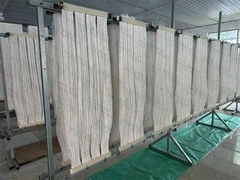
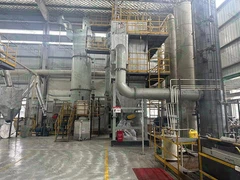
Typical Falling Film Evaporator application: Xylose Extraction by Falling Film Evaporator

Key Advantages of Falling Film Evaporators
Ultra-low energy consumption through gravity-driven flow and efficient thin-film heat transfer.
1
>>
Protection of heat-sensitive materials via short residence time and low-temperature operation.
2
>>
Effective handling of high-viscosity and high-concentration fluids without clogging.
3
>>
Compact, space-saving design with vertical tube modularity for easy scalability.
4
>>
Environmentally friendly operation with reduced water waste and thermal pollution.
5
>>
Anti-fouling performance enabled by high fluid velocity and CIP systems.
6
Falling Film Evaporator Design Considerations
(A) Hydrodynamic and Thermal Efficiency
● Liquid Distribution System: Critical for uniform film formation; uses precision nozzles or perforated plates.
● Boiling Point Elevation (BPE): Impacts temperature gradient design, especially for high-salinity feeds.
● Tube Geometry: Vertical tubes with optimized length/diameter ratios to maintain film stability.
(C) Energy Optimization
● Multi-Effect Integration: Steam reuse across stages to enhance energy efficiency.
● Feed Preheating: Recovers waste heat from condensate or vapor streams.
● Thermal Vapor Recompression (TVR): Optional integration to boost steam economy.
(B) Material and Fouling Management
● Corrosion Resistance:
① SS316L for general use, titanium for chloride-rich environments, polymer-coated surfaces for acidic solutions.
● Fouling Mitigation:
① High fluid velocity to reduce scaling.
② Integrated CIP (Clean-in-Place) systems for periodic maintenance.
(D) Control and Safety
● Automation:
① PLC systems to monitor film thickness, temperature gradients, and feed flow rates.
② Real-time adjustments to prevent dry patches or flooding.
● Safety Mechanisms:
① Low-level alarms to avoid tube overheating.
② Pressure relief valves and emergency shutdown protocols.
Falling Film Evaporator Cost and other factors comparison
|
S/N |
Falling Film Evaporator |
MVR Evaporator |
Multi effect evaporator |
TVR evaporator |
|
Initial investment cost |
Medium (simple structure, but requires a sophisticated distribution system) |
High (compressor cost is high). |
Medium to high (multi-effect complex structure) |
Medium (lower than MVR, but requires high pressure steam source) |
|
Running costs |
Medium (relies on external steam or electric heating) |
Very low (mainly electricity consumption, no external steam demand) |
Low (steam reuse in stages, but first-effect steam is required) |
Medium (high-pressure steam is required to drive the ejector). |
|
Energy efficiency |
Medium-high (depends on temperature difference, no steam cycle) |
Very high (90% energy saving vs. traditional, only a small amount of electricity is needed to drive the compressor) |
High (about 50% energy saving per effect, depends on the number of effects) |
Medium-high (30-50% energy saving, depends on steam injection efficiency). |
|
Maintenance requirements |
Low (no moving parts, but need to be cleaned to prevent clogging) |
Medium-high (compressor maintenance is complex) |
Medium (multi-effect valve and pipeline maintenance) |
Medium (ejector is prone to wear). |
|
Typical Applications |
Dairy products, juice, pharmaceuticals, high-salinity wastewater,papermaking black liquor. |
Chemical concentration, zero discharge (ZLD), high-salinity wastewater |
Seawater desalination, sugar production, low-concentration wastewater |
Dairy, juice |
Falling Film Evaporator Applications
Food and beverage industry
Chemical and pharmaceutical industry
Environmental protection and resource recycling
Petrochemical and energy fields
Biotechnology and fermentation engineering


We're well-known as one of the leading falling film evaporator manufacturers and suppliers in China. Please rest assured to buy custom made falling film evaporator from our factory. Contact us for more details.
Falling Film Type Evaporator, Forced Film Evaporator, Falling Film Evaporator