


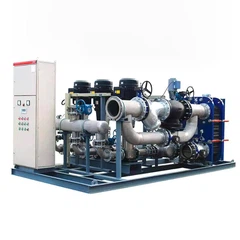
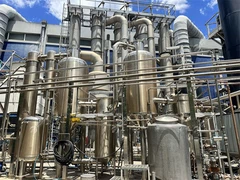
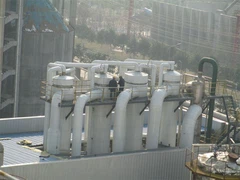
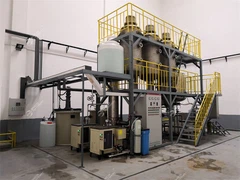






Plate Heat Exchanger
Working principle of plate heat exchanger
The plate heat exchanger uses efficient heat transfer design to recover the waste heat of the low-temperature and low-pressure secondary steam generated during the evaporation process and directly uses it to heat the raw liquid, reducing the demand for external heat sources and improving system energy efficiency.
Here's a step-by-step breakdown:
Fluid distribution
- The cold and hot fluids enter the heat exchanger from the inlet and are distributed to the alternately arranged plate channels through the distribution ports.
- The gasket design between the plates determines the flow path of the fluid: the cold fluid and the hot fluid flow alternately through the channels formed by the adjacent plates.
Countercurrent/parallel flow
- The fluid usually flows in a countercurrent (the cold and hot fluids flow in opposite directions), and in a few cases in a parallel flow. The countercurrent design can maximize the heat transfer temperature difference and improve the heat recovery efficiency.
Heat transfer process
- Heat is transferred from the higher temperature fluid to the lower temperature fluid through the thin metal plate.
- The corrugated structure on the plate surface destroys the laminar boundary layer and generates turbulent flow, which significantly enhances the heat transfer efficiency (3-5 times higher than the shell and tube heat exchanger).
Pressure drop and flow rate management
Corrugated plates will generate a certain pressure drop while enhancing heat transfer. By optimizing the plate corrugation angle and flow channel width, a balance can be achieved between efficient heat transfer and reasonable pressure drop.
Outlet confluence
- The cold and hot fluids that have completed the heat exchange are discharged from the outlet separately without mixing with each other.


Typical plate heat exchanger application: Syrup Concentration plate heat exchanger system

1.High-Quality Crystal Production
- Uniform crystal size distribution due to controlled supersaturation and classification.
- Minimized fines (small crystals) through baffle design and fines dissolution systems.
2.Energy Efficiency
- Low mechanical energy input (agitator-driven circulation).
- Heat recycling from evaporation (if integrated with evaporative crystallization).
3.Versatility
- Adaptable to cooling, evaporative, or reactive crystallization processes.
- Handles a wide range of solutions (e.g., salts, organic compounds, pharmaceuticals).
4.Scalability and Compact Design
- Effective for both pilot-scale and industrial production.
Integrated draft tube and baffle system reduces footprint while maintaining efficiency.
5.Environmentally Friendly
- Closed-loop operation recycles mother liquor, reducing waste.
- Minimal thermal pollution (cooling crystallization avoids steam use).
Key Advantages of ENCO plate heat exchanger:
1. Energy Efficiency
The corrugated plate design generates strong turbulence (Turbulent Flow), with a heat transfer coefficient of up to 3,000–7,000 W/m²·K, significantly reducing energy consumption.
Supports counterflow/crossflow design, maximizes heat transfer temperature difference (LMTD), reduces heat loss, and improves energy saving by 30–50% compared with traditional shell and tube heat exchangers.
2. Reduced External Heating Demand
Waste heat in the process (such as low-temperature steam, waste hot water) can be directly recovered for preheating raw materials or heating other fluids, reducing the demand for external steam or electric heating.
In a closed-loop system, energy self-balancing is achieved through heat circulation, and only a small amount of supplementary energy is required (such as the startup phase).
3. Compact and Modular Design
The heat transfer area per unit volume is 2–5 times that of a shell and tube heat exchanger, saving installation space and suitable for transformation or space-constrained scenarios.
Modular design allows for quick adjustment of heat transfer capacity by increasing or decreasing the number of plates to accommodate process fluctuations or capacity changes.
4. Environmental Benefits
Reduced thermal pollution: Efficient heat transfer reduces cooling water usage and waste heat emissions, alleviating environmental heat load.
Water conservation: In the condensate recovery system, steam condensate can be recycled to reduce wastewater generation.
Long life and low maintenance: Stainless steel/titanium materials are corrosion-resistant, reducing equipment replacement frequency and resource consumption.
Plate heat exchanger design Considerations
(A) Thermodynamics and heat transfer efficiency
1.Plate design and flow channel optimization
- Corrugation angle and depth: affect turbulence intensity and pressure drop, and need to balance heat transfer efficiency and energy consumption (e.g. herringbone corrugation is suitable for high heat transfer, low corrugation angle reduces pressure drop).
- Flow channel layout: counter-flow maximizes heat transfer temperature difference (LMTD), cross-flow is suitable for space-constrained scenarios.
- Temperature difference control: to avoid freezing of fluid on the low-temperature side or local overheating on the high-temperature side, the heat exchange capacity of a single plate needs to be limited.
2.Boiling point elevation (BPE) and scaling management
- When handling high-salt or high-viscosity fluids, it is necessary to increase the plate gap or adopt a wide flow channel design (Free Flow Plate) to prevent scaling and blockage caused by boiling point elevation.
(B) Material and structural reliability
1.Material corrosion resistance
- Conventional media: stainless steel (SS304/SS316) is suitable for water and low-concentration acids and alkalis.
- Strongly corrosive media: titanium (Ti), nickel-based alloy (Hastelloy) or graphite composite materials, used for seawater, chloride ions or organic solvents.
2.Anti-scaling and easy-maintenance design
- Surface treatment: Electropolishing or nano-coating reduces dirt adhesion.
- Removability: Gasket or brazed selection - Gasket is easy to disassemble and wash, brazed is resistant to high pressure but has high maintenance costs.
- Online cleaning (CIP): Design wide flow channels or integrated flushing interfaces to support chemical or mechanical cleaning.
(C) Energy and system integration optimization
1.Waste heat recovery design
- Multi-stage series connection: connect multiple plate heat exchangers in series to utilize the waste heat of high-temperature fluid step by step (such as preheating → heating → superheating).
- Condensation latent heat utilization: direct coupling of the steam condensation side and the liquid heating side to maximize the latent heat recovery efficiency.
2.Pressure drop and flow matching
- Flow distribution uniformity: prevent biased flow from causing a decrease in local heat transfer efficiency through symmetrical flow channel design or flow guide area optimization.
- Pumping energy consumption control: select low-resistance plates (such as low corrugation angle) or adjust the number of flow channels to reduce the total pressure drop of the system.
(D) Control and safety system
1.Automation monitoring
- Parameter monitoring: real-time tracking of inlet and outlet temperature, pressure, and flow, and dynamic adjustment of valve opening or pump speed through PLC or DCS system.
- Leak detection: install humidity sensors in rubber pad PHE to early warn of fluid mixing risks.
2.Safety protection design
- Overpressure protection: set safety valves or bursting discs to prevent overpressure caused by blockage or valve failure.
- Antifreeze protection: configure drain valves or ethylene glycol circulation in cold environments to prevent the low-temperature side fluid from freezing and damaging the plates.
- Blockage prevention: install filters (<1 mm pore size) at the inlet and monitor the pressure difference alarm on both sides.
Plate heat exchanger Cost and other factors comparison
|
S/N |
Plate heat exchanger |
MVR evaporator |
Multi effect evaporator |
TVR evaporator |
|
Operation cost |
Lowest |
High (compressor cost is high) |
Medium to high (the more efficiencies, the higher the cost) |
Medium (below MVR) |
|
Energy source |
Low (heat transfer only, no phase change) |
Very low (90% energy saving vs traditional evaporator) |
Medium (the more efficiency numbers, the more energy-saving) |
Medium to high (depends on high pressure steam efficiency) |
|
Applicable fluid properties |
Low viscosity, particle-free fluid (wide gap plate type can partially improve) |
Clean steam, avoid solid or scaling media |
High viscosity, solid-containing fluid (wide flow channel design) |
Medium viscosity, to avoid particles clogging the injector. |
|
Heat source |
External heat source (steam/hot water) or waste heat recovery. |
Electricity drives the compressor, recycling the latent heat of steam. |
External steam (first effect) + internal steam circulation. |
High pressure raw steam drives the ejector. |
DTB Crystallizers Applications:
◉ Zero discharge of high salt wastewater
◉ Chemical industry
◉ Pesticide industry
◉ Lithium extraction
◉ Polysilicon industry
◉ Printing and dyeing industry
◉ Waste leachate treatment
◉ Pharmaceutical industry
◉ Metallurgical industry
◉ Fermentation industry
◉ Evaporator/condenser of ground source heat pump
◉ Food and beverage industry


We're well-known as one of the leading plate heat exchanger manufacturers and suppliers in China. Please rest assured to buy custom made plate heat exchanger from our factory. Contact us for more details.