


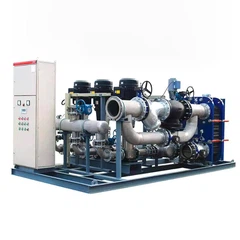
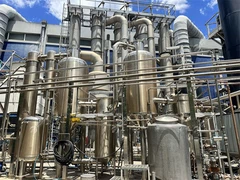
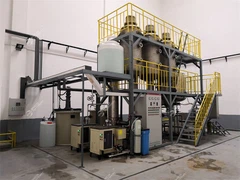






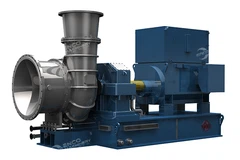
Double Effect Evaporator
Working Principle of Double Effect Evaporator
A double effect evaporator is a multi-stage system that reuses vapor generated in one stage (the "first effect") to heat the next stage (the "second effect"), significantly improving energy efficiency compared to single-effect evaporators.


Step-by-Step Breakdown
- The process liquid (e.g., wastewater, brine, or juice) enters the first effect evaporator.
- Fresh steam (high-temperature, high-pressure) is introduced into the heat exchanger to heat the liquid.
- As the liquid boils, water evaporates, producing primary vapor and leaving a partially concentrated solution.
- The primary vapor from the first effect is routed to the second effect evaporator.
- The second effect operates at a lower pressure (and thus a lower boiling point), allowing the primary vapor to serve as the heating source for the second stage.
- The partially concentrated liquid from the first effect is fed into the second effect.
- The primary vapor condenses in the second effect’s heat exchanger, transferring latent heat to evaporate additional water from the liquid.
- This generates secondary vapor and further concentrates the liquid.
- The pressure difference between the two effects ensures efficient heat transfer:
① The first effect operates at higher pressure/temperature.
② The second effect operates under vacuum or lower pressure, enabling vapor reuse.
- This staged design reduces fresh steam consumption by nearly 50% compared to single-effect systems.
- Double effect evaporators achieve higher steam economy (kg of water evaporated per kg of steam used).
- Typical steam economy is ~1.8–2.0, meaning 1 kg of fresh steam evaporates ~2 kg of water.
- Electrical energy is primarily used for pumps and vacuum systems.
- Condensed steam from both effects is collected as distillate (pure water).
- The final concentrated liquid is discharged from the second effect.
- Non-condensable gases are removed via vacuum systems to maintain pressure gradients.
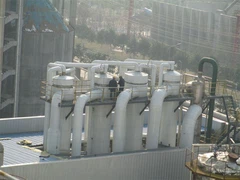
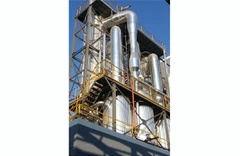
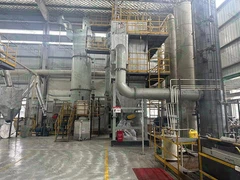
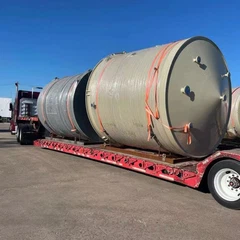
Typical Double-Effect Evaporation: Na2SO4 wastewater Treatment Project in China

Key Advantages of Double-Effect Evaporation
Reduced energy costs by reusing vapor between effects.
Suitable for heat-sensitive materials due to lower boiling points in subsequent effects.
Scalable design (can be extended to triple-effect or more for higher efficiency).
Key considerations for double-effect evaporator design

(A) Thermodynamic efficiency and system design
1. Pressure gradient design between effects
● High pressure in the first effect and low pressure in the second effect: The vacuum system is used to maintain the low pressure environment of the second effect to ensure that the secondary steam from the first effect can be effectively transferred to the second effect as a heat source.
● BPE compensation: The BPE of high-salinity or high-viscosity solutions must be included in the calculation to avoid insufficient evaporation temperature in the second effect.
2. Steam Economy
● The target steam economy is 1.8–2.0 (i.e. 1 kg of fresh steam evaporates 1.8–2.0 kg of water), and the heat transfer temperature difference and heat transfer area between effects need to be optimized.
● Secondary steam condensation heat recovery: The waste heat of condensed water is used for preheating the raw liquid.
3. Heat transfer area and temperature difference distribution
● The heat transfer area of the first effect needs to match the high temperature characteristics of the fresh steam, and the second effect needs to adapt to the low pressure and low temperature conditions.
● Avoid too small (resulting in reduced heat transfer efficiency) or too large (resulting in scaling risk) temperature difference between effects.
(B) Material selection and anti-scaling design
1. Material corrosion resistance
● First effect: SS316L or duplex stainless steel is preferred for high temperature and high pressure environments.
● Second effect: If treating chloride ion solutions (such as seawater desalination), titanium or nickel-based alloys (such as Hastelloy) are required.
2. Anti-scaling and cleaning strategies
● Design smooth pipe inner walls to reduce scale deposition.
● Integrate CIP online cleaning system (such as acid/alkali washing cycle) to regularly remove scale deposits in inter-effect heat exchangers.
● For materials prone to scaling, anti-scaling agents can be added or forced circulation pumps can be used to enhance fluidity.


(C) Energy optimization and heat recovery
1. Preheating system
● Before the raw liquid enters the first effect, it is preheated by using condensed water or waste heat from the second effect secondary steam through a preheater to reduce fresh steam consumption.
2. Condensate recovery
● The condensed water (high purity) from the first and second effects can be recovered for boiler water replenishment or process reuse.
3. Vacuum system optimization
● Use high-efficiency steam jet pumps or liquid ring vacuum pumps to reduce the second effect pressure to 0.1–0.3 bar (absolute pressure) to ensure effective use of the temperature difference between effects.
(D) Control system and safety design
1. Automation control
● PLC/DCS system Real-time monitoring:
① Liquid level, temperature, and pressure of the first and second effects.
② Flow balance of material conveying pumps between effects.
● Pressure balance control: Maintain a stable pressure gradient between effects by adjusting the power of the vacuum pump and the opening of the valve between effects.
2. Safety protection
● Anti-dry burning protection: Automatically shut down the heating steam when the liquid level in the effect is too low.
● Vacuum system fault alarm: Prevent abnormal increase in the second effect pressure from causing evaporation stagnation.
● Overpressure relief valve: To deal with the risk of over-limit steam pressure in the first effect.

Double-Effect Evaporation Cost and other factors comparison
|
S/N |
Double-Effect Evaporator |
MVR Evaporator |
Single-Effect Evaporator |
TVR Evaporator |
||
|
Initial investment cost |
Medium |
High |
Low |
Medium |
||
|
Operating Cost |
Medium-Low (depends on steam price) |
Low (depends on electricity price) |
High (high steam consumption) |
Medium (steam + minor electricity) |
||
|
Energy efficiency |
Moderate (thermal energy cascade utilization) |
|
Low |
Moderate (depends on ejector efficiency) |
||
|
Maintenance requirements |
Low (pumps, vacuum system) |
High (compressor, seals) |
Low (pumps, heaters) |
Medium (ejector, valves) |
||
|
Typical Applications |
Steam-rich regions, continuous medium-scale production |
Low electricity cost, high-concentration/high-BPE solutions |
Small-scale/batch operations |
Steam availability with moderate energy savings |
Food and beverage industry: juice concentration, dairy processing (such as condensed milk), syrup production.
Chemical industry: salt crystallization (such as sodium chloride, sodium sulfate), solvent recovery (ethanol, methanol).
Pharmaceutical industry: concentration of Chinese medicine extracts, purification of active ingredients in fermentation broth.
Wastewater treatment: industrial wastewater reduction, high-salt wastewater pre-concentration (for zero liquid discharge system).
Seawater desalination: pretreatment of seawater or brackish water to reduce the load of reverse osmosis system.
Pulp and paper industry: black liquor concentration and recovery of chemicals (such as lignin, caustic soda).
Environmental protection field: volume reduction treatment of hazardous waste (radioactive liquid, oil sludge).
Energy industry: concentration and reuse of cooling tower wastewater.
Metal processing: recovery of metal ions from electroplating wastewater (such as nickel and zinc).
Agriculture: liquid fertilizer concentration or pesticide solution recovery.


We're well-known as one of the leading double effect evaporator manufacturers and suppliers in China. Please rest assured to buy custom made double effect evaporator from our factory. Contact us for more details.
Climbing Film Evaporator, Double Effect Evaporator, Film Evaporator