


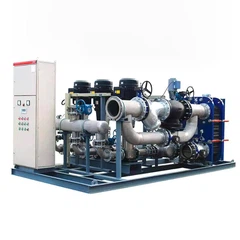
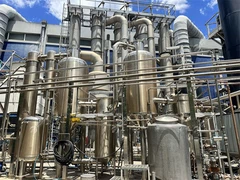
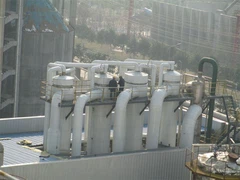
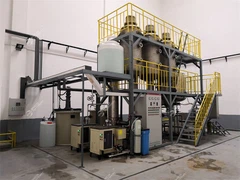
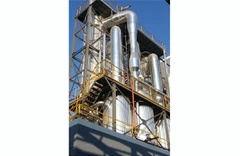
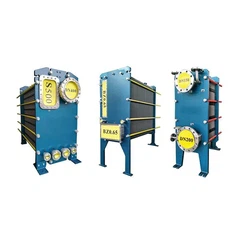


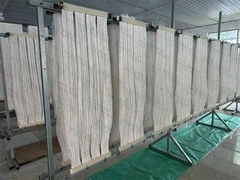


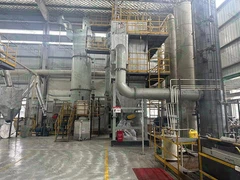


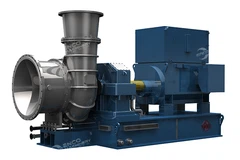
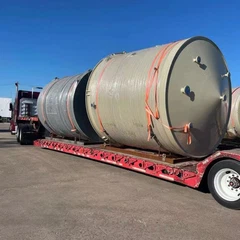


Details of Quadrant effect evaporator
In Sodium sulfate four-effect evaporator, the latent heat of secondary steam is fully utilized, which improves the utilization rate of heating steam. According to the operating pressure, it can be divided into normal pressure, pressurized and reduced pressure evaporation. In pressurized evaporation, the obtained secondary steam temperature is higher and can be used as heating steam for the next effect. Therefore, single-effect evaporation is mostly vacuum evaporation; the front effect of multi-effect evaporation is pressurized or normal pressure operation, while the rear effect is operated under vacuum.
From the more primitive evaporation kettle, it has developed into single-effect, double-effect, triple-effect, quadruple-effect or more effect evaporators, all of which aim to gradually reduce energy consumption.
The system consists of four evaporators connected in series. It uses the secondary steam generated by the previous effect evaporation to provide a heat source for the next effect to achieve the purpose of energy saving.
The four-effect can recover part of the secondary steam. The more the number of effects, the more secondary steam is recovered. This is different from the MVR evaporator, which can recover all the secondary steam.
The process of four-effect evaporation: there can be downstream, countercurrent, horizontal flow, cross flow, etc. According to the operation mode, it can be divided into continuous or intermittent. Most evaporation processes in industry are continuous and stable operation processes.
According to the utilization of secondary steam, it can be divided into single-effect evaporation and multi-effect evaporation. If the secondary steam generated is not utilized and is directly discharged after condensation by the condenser, this operation is called single-effect evaporation. If the secondary steam is led to another evaporator with a lower operating pressure as heating steam, and several evaporators are used in series, this operation is called multi-effect evaporation.
The four-effect evaporator can adopt various forms such as forced circulation, natural circulation, falling film, rising film, plate evaporator, etc., and can also adopt various combinations to optimize the process.
(1) Material flow
The material to be concentrated passes through the feed pump, the flow meter, the plate heat exchanger, the shell and tube heat exchanger to the first-effect separator, and enters the first-effect heater for heating under the action of the first-effect circulation pump. The generated secondary steam and concentrated material leave the tube bundle, and most of the material is collected in the buffer pump at the bottom of the separator and pumped out to the second effect, and part of the material is evaporated by the circulation pump. In the separator, the steam and liquid are separated, and the secondary steam leaves the top of the separator to the second-effect heater for heating.
The material evaporates from the first effect to the second and third effects in the same principle, and evaporates continuously through three evaporation units; forced circulation is used for the fourth effect. When the material reaches saturation, the crystals pass through the TDB crystallizer, and the crystals are precipitated and discharged to the crystallization tank for cooling and crystallization before entering the separator for separation. The mother liquor is circulated and evaporated by a forced circulation pump.
(2) Raw steam, secondary steam, and condensed water process
The main energy source for heating the equipment is low-pressure raw steam. The steam enters the evaporator shell tube through the steam control valve and exchanges heat with the material. After being condensed, it flows into the second effect shell from the bottom of the heater shell. The secondary steam evaporated from the first effect comes out from the top of the first effect separator to heat the second effect shell and is condensed from the bottom of the second effect heater and mixed with the first effect condensed water to the bottom of the third effect heater. Similarly, the secondary steam evaporated from the second effect is heated by the third effect, and the secondary steam evaporated from the third effect is heated by the fourth effect. After condensation, it is mixed with the condensed water of the first, second, and third effects to the fourth effect shell, and finally condensed in the condenser. The condensed water of the entire system is pumped away. The part of the gas that cannot be condensed is sucked out by a vacuum pump to keep the equipment vacuum.
ENCO's four-effect evaporation system often considers the recovery of condensed water or secondary steam heat to achieve energy saving. In wastewater treatment, automatic online cleaning of preheater scaling should also be considered.
Please contact us if you need any support:
Name: Kelvin
Mobile/Whatapp No.: M/W:+86 18593449637
Email: kelvin@cnenco.com