


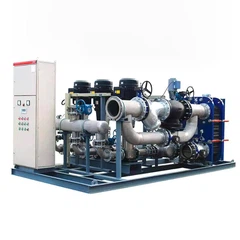
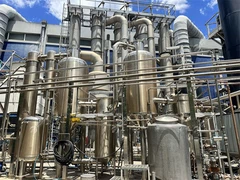
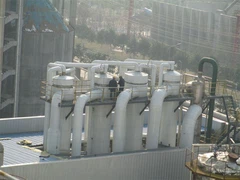
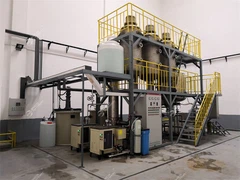
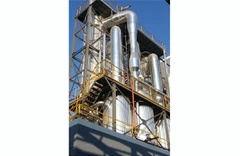
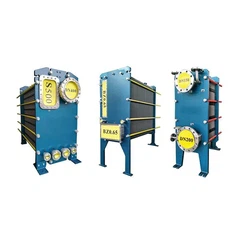


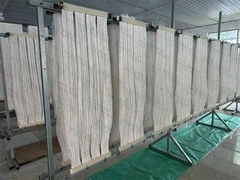


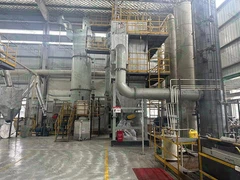


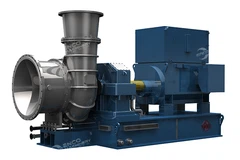
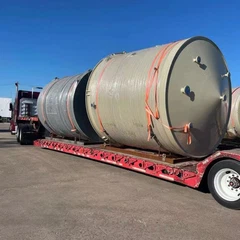
A multi effect evaporator consists of multiple single stage evaporators connected in series, each stage being called an efficiency. The operating pressure and boiling point of the solution in the post effect of the multi effect evaporator are always lower than those in the pre effect. The secondary steam evaporated from the pre effect is used as the post effect heat source, and the post effect heater is the condenser of the pre effect. Due to multiple reuse of secondary steam, the total evaporation can reach several times the consumption of new steam. Multi effect evaporators have multiple effects, and the pressure and temperature of each effect are different, which also involves the problem of material overflow between effects. The operation difficulty is relatively high, and the configuration of automation facilities will reduce the operation difficulty. However, human intervention is still needed to determine whether the control indicators are in normal working condition.
1. The superheat of the heat source steam. Excessive superheat of the heat source steam can have a significant impact on the heat transfer efficiency of one effect heating. Excessive superheat needs to be eliminated by adding spray water to achieve the desired usage effect. The heating pressure of saturated steam is lower than that of superheated steam, which will result in better heat transfer efficiency.
2. Heat source steam pressure. The steam pressure of the heat source is the driving force generated by evaporation, and a necessary condition for sufficient steam pressure evaporation capacity. Within the design range, the higher the pressure of the primary steam supply, the faster the evaporation rate.
3. Final vacuum degree. The final vacuum degree and the pressure of the primary heat source provide the overall heat transfer power for the multi effect evaporator. Therefore, a higher final vacuum degree results in smoother system evaporation. Under normal conditions, a final vacuum degree of<-0.08MPa is preferred. When the final vacuum degree decreases, it is necessary to check whether the condenser is scaled or blocked, whether the circulating cooling water volume is sufficient, and whether the circulating water supply temperature is sufficiently low. Of course, under normal operating conditions, the final vacuum degree will decrease with the increase of the pressure of the first effect heating steam, mainly due to an increase in evaporation rather than a malfunction.
4. Each effective liquid level. Stable liquid level can prevent excessive evaporation or scaling of the evaporator main pipe.
5. Each effective temperature. The difference between the temperatures of each effect minus the corresponding increase in the boiling point of the upper effect is the heat transfer temperature difference of this effect, or by directly installing a temperature gauge in the heater and separator, the heat transfer temperature difference of this effect can be visually read. Under the premise of the same evaporation capacity, the pressure difference of each effect is relatively stable, and a certain effect with a significant increase in temperature difference may indicate a decrease in heat transfer efficiency. It is necessary to check whether there is scaling, material throwing blockage, smooth drainage of the heat exchanger, and blockage of the secondary steam pipeline on both sides of the heat exchanger.
6. Differential pressure of each effect. The effect of each pressure difference is similar to that of temperature difference, which can be used to check whether the main effect is blocked, scaling, and other fault states.
7. Steam consumption per unit. Steam consumption is the main indicator of system energy consumption. Under specific process conditions, steam consumption is relatively stable. When there is inter effect steam leakage, the system steam consumption significantly decreases. The main investigation is to check whether the condensate discharge pipe of each effect heater is leaking steam, and whether the non condensing valve is opened too large.
Control Indicators Of Multi Effect Evaporators
Dec 04, 2023
Leave a message