


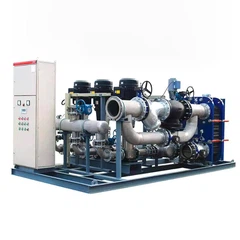
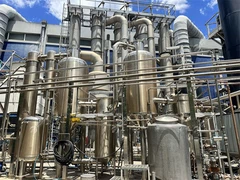
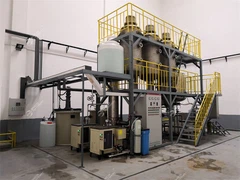






MVR evaporator is an abbreviation for mechanical vapor compression in English. MVR is a technology that reuses the energy generated by its own secondary steam to reduce the demand for external energy.
The secondary steam, after being compressed by the compressor, increases in pressure and temperature, and the enthalpy increases accordingly. It is sent to the heating chamber of the evaporator as heating steam, which is used as generating steam to maintain the evaporation state of the material liquid. The heating steam itself transfers heat to the material itself and condenses it into water. In this way, the steam that was originally to be discarded is fully utilized, latent heat is recovered, and thermal efficiency is improved.
As early as the 1960s, Germany and France had successfully applied this technology to industries such as chemical, pharmaceutical, papermaking, wastewater treatment, and seawater desalination.
The working process involves compressing the low-temperature steam through a compressor, increasing the temperature and pressure, increasing the enthalpy, and then entering the heat exchanger for condensation to fully utilize the latent heat of the steam. Except for start-up, there is no need to generate steam during the entire evaporation process.
In the process of multi effect evaporation, the secondary steam of a certain effect in the evaporator cannot be directly used as the primary heat source, but can only be used as a secondary or secondary heat source. As a primary heat source, additional energy must be provided to increase its temperature (pressure). The steam jet pump can only compress a portion of the secondary steam, while the MVR evaporator can compress all the secondary steam in the evaporator.
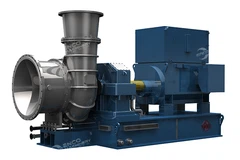
The solution is circulated in a falling film evaporator through a material circulation pump within the heating tube. The initial steam is heated by fresh steam outside the pipe, which heats and boils the solution to produce secondary steam. The resulting secondary steam is sucked in by a turbocharged fan, and after pressurization, the temperature of the secondary steam increases. It serves as a heating source and enters the heating chamber for cyclic evaporation. After normal start-up, the turbo compressor sucks in the secondary steam, which is pressurized and converted into heating steam, continuously circulating and evaporating. The evaporated water eventually turns into condensate and is discharged.
Due to cost reasons, single-stage centrifugal compressors and high-pressure fans are commonly used in mechanical steam recompression systems. Therefore, the following explanation is for this type of design. A centrifugal compressor is a volume control machine, which maintains a volume flow rate almost constant regardless of the suction pressure. The change in mass flow rate is proportional to the absolute suction pressure.
The compression cycle of a single-stage centrifugal compressor is depicted in an enthalpy entropy diagram. Power required for a single-stage centrifugal compressor:
For example, compressing saturated water vapor from the evaporator from the suction state p1=1.9 bar, t1=119 ℃ to p2=2.7 bar, t2=161 ℃ (compression ratio Π= 1.4). The compression cycle follows a polytropic curve 1-2, increasing the specific enthalpy of steam Δ HP. For the specific enthalpy h2 of steam, it enters the heater of the evaporator at this temperature through the equation of the internal efficiency (isentropic efficiency) of the compressor. Based on the amount of steam inhaled, kg/hr. HP unit variable (effective) compression work, kJ/kg. Hs unit isentropic compression work, kJ/kg.
The isentropic efficiency (internal efficiency) of a compressor depends, among other factors, on the polytropic index of the unit variable compression work hp κ And the molar mass M of the inhaled gas, as well as the inhalation temperature and required pressure rise. For the actual coupling power of the prime mover (electric motor, gas engine, turbine, etc.), a larger mechanical loss margin is considered. A single-stage centrifugal compressor with a impeller made of standard materials can achieve a water vapor pressure rise with a compression factor of 1.8. If higher quality materials such as titanium are used, the compression factor can reach up to 2.5. In this way, the final pressure p2 is 1.8 times the suction pressure p1, or a maximum of 2.5 times, which corresponds to an increase in saturated steam temperature of about 12-18K, with a maximum temperature rise of up to 30K, depending on the suction pressure. As for evaporation technology, the usual practice is to represent its pressure based on the corresponding boiling point temperature of water. In this way, the effective temperature difference is directly represented.
The principle of mechanical steam recompression
The evaporation equipment is compact, occupies a small area, and requires small space. It can also eliminate the cooling system. For existing factories that require expansion of evaporation equipment for steam supply, insufficient water supply capacity, and insufficient space, especially in situations where low-temperature evaporation requires condensation of chilled water, it can achieve both investment savings and good energy-saving effects.
Basic Principle Of MVR Evaporator
Dec 12, 2023
Leave a message