









What Is the Workflow of a Modern Glucose Syrup Production Line?
Producing high-quality glucose syrup from starch isn't just a series of machines running; it's a carefully balanced biochemical, separation, and evaporation concentration system. In this article, I'll detail each major stage of a typical industrial glucose syrup plant, document key control parameters, and describe the critical factors at each step. The goal: to provide a clear process flow diagram and offer engineering insights into the various trade-offs between energy consumption, yield, and purity.

Raw Material Handling and Starch Extraction
Feedstock selection and cleaning
A glucose syrup line often starts with a starch-rich raw material: corn (maize), wheat, cassava, potato, or rice (or blends thereof).
First, the raw grains or roots are cleaned (dust, stones, foreign matter) and, if needed, destoned or dehulled. For tuber sources, peeling or washing may be required. The cleaning stage ensures downstream steps avoid abrasion, contamination, or enzyme inhibition by mechanical impurities.
In many plants, the cleaned raw material is soaked or steeped in water (sometimes with sulfur dioxide or mild acid) to soften the matrix and loosen fiber, which helps in later separation.
Milling, liquefaction, and starch separation
After soaking, the raw material is milled (wet milling) to expose starch granules and release other cellular components. The slurry is then fractionated: fiber, protein (gluten in corn/wheat), and starch are separated by screens, centrifuges, or hydrocyclones.
The starch slurry often undergoes a washing stage (multiple water washes) to reduce soluble impurities (sugars, salts, soluble proteins). These washing steps help ensure that the starch entering hydrolysis is relatively pure.
At this point, one obtains a starch suspension (typically, 30–40 % solids) with reduced fibrous, proteinaceous, and colorant loads.
Gelatinization and Liquefaction (Partial Hydrolysis)
To convert solid starch granules into soluble dextrins, two main steps are required: gelatinization followed by liquefaction.
Gelatinization / cooking
The starch slurry is heated under controlled conditions (e.g., 80–95 °C, depending on starch type) so that the granule structure breaks down, water penetrates, and amylopectin/amylose chains become hydrated and mobile. This "gelatinization" is essential for enzyme penetration.
pH is often adjusted (acid or buffer) and calcium ions or salts may be added to stabilize the slurry and partially control viscosity. A small amount of thermostable α-amylase may also be introduced early to prevent over-thickening.
Liquefaction (α-amylase action)
Once gelatinized, a thermostable α-amylase enzyme is added (often produced by Bacillus species) to cleave internal α-1,4 glycosidic bonds, converting starch chains into shorter dextrins (oligosaccharides). This step typically runs at elevated temperature (e.g. 85–105 °C, depending on enzyme stability) under controlled pH (around 5.5–6.5).
The result is a liquefied dextrin slurry with reduced viscosity, which is easier to handle for subsequent saccharification steps.
At this point, the slurry may be diluted or cooled somewhat to optimize conditions for the next enzymatic stage.

Saccharification (Conversion to Glucose + Maltose)
This is the key conversion zone in the line - turning dextrins into glucose and shorter sugars.
Enzyme selection, dosage, and kinetics
A common approach is to use glucoamylase (also called amyloglucosidase) which cleaves α-1,4 and α-1,6 linkages from nonreducing ends, releasing glucose monomers. Some processes also add debranching enzymes (e.g. pullulanase) to break amylopectin branches for higher yield.
Patents and literature suggest that high purity glucose syrups (>98 % glucose on dry solids) can be achieved by saccharifying a dextrin solution of 10–20 % solids using enzyme dosages in the range 0.30–1.0 AG units/g starch, for reaction times on the order of 15–25 h, at ~55–60 °C, pH ~4.0–5.0.
These conditions strike a balance: too little enzyme or too low temperature → incomplete hydrolysis; too long a reaction or overdosing enzyme → risk of side reactions, deactivation, or color generation.
Saccharification reactor design
The saccharification is often performed in stirred tank reactors (batch or continuously fed reactors). Temperature control and mixing are crucial: hot spots or gradients lead to denaturation or enzyme inefficiencies.
During saccharification, the solids fraction is kept moderate (10–20 %) to maintain enzyme diffusion and maintain manageable viscosity. Monitoring of glucose concentration (via HPLC or polarimetry) enables dynamic termination once the desired dextrose equivalent (DE) or glucose purity is reached.
Once the target is reached, the reaction is quenched (usually by heating to ~80 °C for enzyme denaturation or pH shift).
Thus ends the core conversion stage; the stream now contains glucose, maltose, unconverted oligosaccharides, and residual enzyme/inhibitors.
Solid Removal, Clarification, and Decolorization
After saccharification, the syrup mixture contains fine insoluble particles, residual proteins, and color-causing impurities. These must be removed to meet food-grade specifications.
Solid filtration / centrifugation
The hot saccharified syrup is passed through filters or centrifuges to remove residual particulates, enzyme aggregates, or insoluble residues. Some processes use filter presses, cloth filters, or rotary screens.
If proteins remain, a deproteinization step (e.g. using protease, heat coagulation, or acid precipitation) may be applied before or during filtration.
Decolorization / activated carbon adsorption
To lighten color, activated carbon (or other adsorbents such as bone char, resin, or clay) is added and mixed under controlled conditions (temperature, contact time) to adsorb colored compounds, phenolics, and humic substances. In many lines, this is done in two stages (coarse and fine decolorization).
After adsorption, the syrup is filtered again to remove the carbon or adsorbent particles.
Ion exchange (deionization) polishing
Finally, to meet battery of ion purity metrics (e.g. low ash content, low conductivity, low mineral content), the syrup is passed through cation and anion exchange resins (in series or mixed beds). This step helps remove residual salts, inorganic ions, and trace metals.
After this polishing, the syrup becomes a clarified, low-color, low-ion glucose syrup solution, ready for concentration.
Evaporation & Concentration
The clarified syrup is still dilute (often 15–30 % solids). The next goal is to concentrate it to a final solids content (e.g. 60–85 %, depending on product spec) with minimal color change, caramelization, and energy consumption.
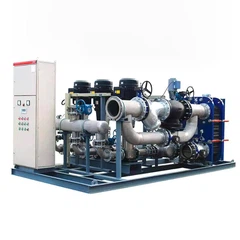
This is where multi-effect evaporators and MVR evaporators come into play - but as components of the overall flow, not the headline.
Multi-Effect Evaporator (MEE) integration
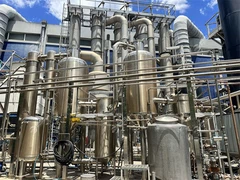
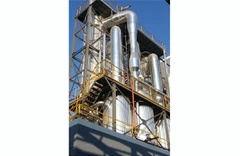
A typical conventional choice is a multi-effect evaporator (MEE, often 3–5 effects). In a multi-effect system, live steam heats the first effect, whose vapor drives the next effect, and so on, thereby reusing energy.
In practice, falling-film, rising-film, or forced-circulation designs are common, depending on viscosity, fouling tendency, and scaling. The design tries to maintain low temperature difference per effect to protect syrup quality (e.g. 5–10 K per effect).
In one example, a four-effect falling film direct-flow evaporator can take a 26 % syrup to 86 % solids across four stages.
The downside: each additional effect means more equipment, piping, condensers, and increased capital cost. Also, fresh steam demand still exists; multi-effect systems rarely eliminate steam demand entirely.
MVR Evaporator (Mechanical Vapor Recompression) usage
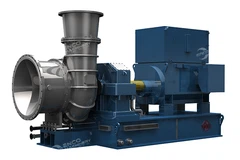
To reduce fresh-steam consumption, many modern plants incorporate an MVR evaporator or hybrid MVR + MEE systems. In an MVR evaporator, low-pressure vapor from the evaporator is compressed mechanically (e.g. via a vapor recompression compressor), raising its temperature/pressure and feeding it back as heating vapor. This effectively recycles latent heat and sharply reduces external steam needs.
Because of this, energy consumption (fresh steam) is minimized, and the system footprint is smaller (fewer vessels) compared to a pure MEE system.
However, the mechanical complexity, capital cost of compressors, and requirement for reliability are nontrivial. Some designs combine multi-effect evaporation with MVR ("MVR‐augmented MEE") to strike a compromise.
From a process flow standpoint, the evaporator train is the last concentration step - after evaporation, condensed water is rejected, and the concentrated syrup (e.g. 60–85 % solids) is sent onward.
Key control considerations in evaporation
- Temperature control & vacuum: operate under vacuum to lower boiling temperatures (thus limiting thermal degradation of sugars).
- Film thickness & flow regime: ensure falling-film or thin-film flow to maintain high heat transfer and prevent tube-drying or fouling.
- Scaling & crystallization risk: monitor and control supersaturation and impurity levels to avoid deposits.
- Energy balance & recompression ratio: in MVR, sizing the compressor and the recompression ratio is critical to match vapor loads and energy recovery.
- Residence time: minimize hold-up to reduce heat damage and color development.
Product Handling, Storage, and Packaging
Once the syrup is concentrated to specification, it enters the finishing and dispatch stages.
- Cooling and hold-back blending: a portion may be diluted to adjust viscosity or to blend grades.
- Final quality check (color, Brix, microbial load, residual ions).
- Storage in insulated tanks (often nitrogen-blanketed or inert-gas layered to suppress microbial growth).
- Pumping to packaging or bulk tanker loading (e.g. ISO tanks, drums, totes).
Plants often maintain a buffer storage capacity so that evaporation and finishing can run continuously.
Process Flow Summary (Block Flow)
Here is a simplified block-flow summary of a modern glucose syrup plant:
- Feedstock cleaning & steeping
- Milling & starch washing
- Gelatinization / cooking
- Liquefaction (α-amylase)
- Saccharification (glucoamylase ± pullulanase)
- Enzyme deactivation / quenching
- Filtration / solid removal
- Decolorization / activated carbon
- Ion exchange polishing
- Evaporation / concentration (MEE / MVR)
- Cooling & blending
- Product storage & dispatch
At each step, controls of pH, temperature, mixing, residence time, enzyme dosage, filtration efficiency, and vacuum/steam balance interact. The evaporation block is critical from an energy standpoint, but the upstream

Trade-Offs, Best Practices & Engineering Notes (From Experience)
Yield vs. Purity trade-off
Pushing saccharification to complete conversion (e.g. >98 % glucose) is desirable, but overextending the reaction can degrade sugars or generate side products, reducing purity or color. Real plants often aim for a sweet spot (e.g. 95–98 %) and rely on polishing steps. (See patent suggestions on enzyme dosage/time)
Enzyme cost and reuse
Enzymes represent a significant variable cost. Some plants recover or recycle enzyme fractions (e.g. via membrane separation) or adjust enzyme dosing dynamically based on feed variability.
Fouling, scaling, and maintenance
Impurities or residual solids lead to fouling in heat exchangers and evaporator tubes. Periodic cleaning (CIP), anti-scaling treatments, and redundant loops are typical design allowances.
Energy optimization
The evaporation block is the largest energy sink. Strategic selection between multi-effect, MVR, or hybrid systems must consider local energy costs, availability of steam, capital vs operating cost. Many plants optimize for lowest total cost (CAPEX + OPEX) over 10–20 year horizons.
Automation and control
Modern glucose syrup lines employ advanced control systems (PID, model predictive control) to monitor Brix, temperature, viscosity, enzyme conversion, ion concentrations, flow-balances, vacuum control, and compressor load for MVR units. Good instrumentation improves yield recovery, reduces drift, and prevents off-spec syrup.
Scale-up and modularization
Modular skids or packaged units (especially for evaporation and saccharification) can accelerate commissioning and reduce on-site engineering risk. But integration (piping, utilities, instrumentation) remains nontrivial.
Incorporating Keywords: MVR Evaporator and Multi-Effect Evaporator
To tie this all together with your required keywords:
- In this flow, the MVR evaporator is deployed as a high-efficiency energy recovery tool, recycling vapor into heating steam and reducing fresh steam use. Its role is critical in the final concentration stage but is subordinate to the core biochemical conversion line.
- The multi-effect evaporator remains a reliable baseline scheme (3–5 effects) for concentration, often used alone or in hybrid with MVR, trading off capital complexity for robustness.
- The keyword glucose syrup flows through the entire article as the product being made; each process block contributes to converting starch into clean, concentrated glucose syrup.
Conclusion: Why This Process Architecture Matters
From an engineering lens, a glucose syrup production line is a layered interplay of biochemistry (enzymes, kinetics, pH, temperature) and separation engineering (filtration, adsorption, ion exchange, evaporation), orchestrated under energy, yield, and quality constraints.
The evaporation block (whether multi-effect or MVR) is essential, but not the defining part of the flow: if upstream conversion or purification fails, no evaporator can salvage a low-purity feed.
In practice, a well-designed line balances:
- High conversion yield
- Low color and impurity load
- Minimal fouling / downtime
- Energy efficiency (via MVR or MEE)
- Flexibility and control
This "glucose syrup factory inside-out" perspective helps a process engineer understand how to size equipment, design control loops, and make trade-offs across the line.