









What Defines a Lyophilizer's Role in Modern Preservation?

In countless industries, from pharmaceuticals to food processing, maintaining the integrity and shelf life of sensitive materials is paramount. The lyophilizer, commonly known as a freeze dryer, is a specialized piece of equipment designed to achieve this through a process called lyophilization or freeze-drying. This technique removes water or other solvents from a frozen product by sublimation, bypassing the liquid phase.
Unlike conventional drying methods that use heat, lyophilization preserves the physical and chemical characteristics of delicate substances, making it indispensable for heat-sensitive or high-value materials. This article delves into the core functions, diverse applications, and common challenges faced by users, providing practical insights into this critical preservation technology.
1. Understanding the Core Functions of a Lyophilizer
How Does a Lyophilizer Work?
The process of lyophilization involves three main stages:
Freezing: The product is first frozen to a temperature typically between -40°C and -80°C. This ensures that all the water in the product is converted into ice, creating a solid matrix. The freezing rate significantly impacts the final product structure.
Primary Drying (Sublimation): Once frozen, the product is placed in a vacuum chamber. As the pressure is reduced, the ice sublimes directly into water vapor, leaving behind a porous solid structure. This stage removes about 95% of the water. Shelf temperature is carefully controlled to provide the energy for sublimation without melting the ice.
Secondary Drying (Desorption): In this final stage, the temperature is increased further, but still below 0°C, to remove residual unfrozen water molecules that are adsorbed to the solid matrix. This lowers the moisture content to typically 1-4%, creating a highly stable product.
The resulting product is a lyophilized powder or solid cake, which is highly porous and can be easily reconstituted.
Key Components of a Lyophilizer
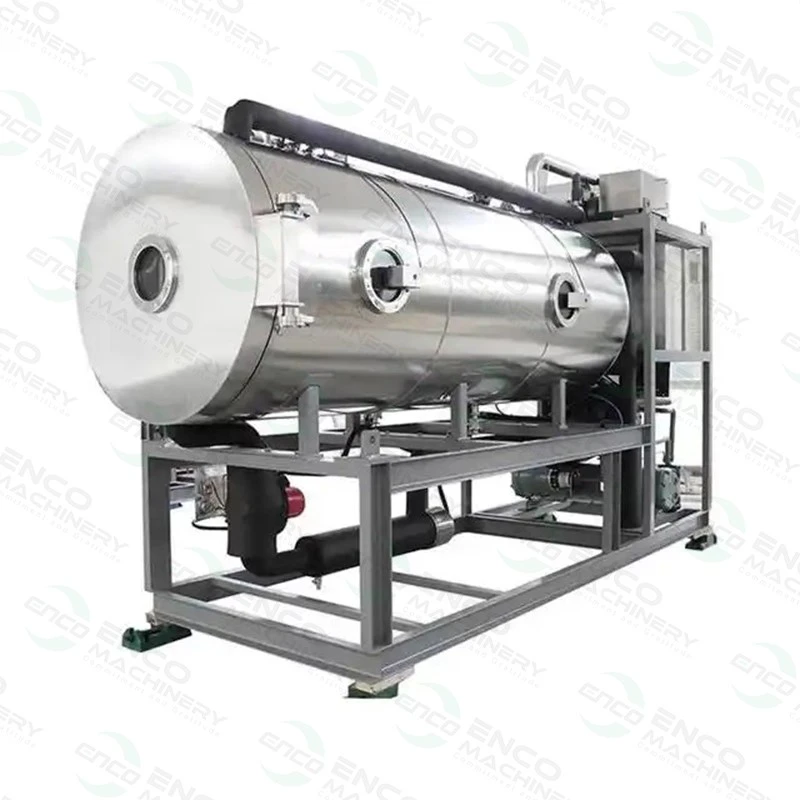
A typical lyophilizer consists of several crucial components:
Product Chamber: Where the frozen product is placed on shelves that can be heated or cooled.
Condenser (Cold Trap): A refrigerated surface, typically at -50°C to -120°C, that captures the sublimed water vapor, preventing it from damaging the vacuum pump.
Vacuum System: Consisting of a vacuum pump and associated valves, it reduces the pressure in the chamber and condenser to facilitate sublimation.
Refrigeration System: Cools both the shelves for freezing and the condenser for vapor trapping.
Control System: Monitors and precisely regulates temperature, pressure, and time for each stage of the process.
These components work in concert to create the precise conditions required for effective freeze-drying.
2. Diverse Applications Across Industries
Pharmaceuticals and Biotechnology: The Gold Standard
The pharmaceutical industry is perhaps the largest user of lyophilized products. Many injectable drugs, vaccines, and biologics are highly sensitive to heat and moisture. Lyophilization preserves their active ingredients, extending shelf life from months to years, which is critical for global distribution.
Vaccines: Many vaccines (e.g., MMR, smallpox) are freeze-dried to maintain potency.
Biologics: Proteins, antibodies, and enzymes are often lyophilized to prevent denaturation.
Injectable Drugs: Antibiotics, hormones, and other drugs that degrade in liquid form.
The resulting lyophilized powder can be easily dissolved in a diluent just before administration, ensuring patient safety and therapeutic efficacy.
Food and Beverage: Preserving Flavor and Nutrition
While heat drying alters taste and nutritional content, lyophilization maintains the original characteristics of food items. This makes it ideal for:
Instant Coffees and Teas: Preserving delicate aromas and flavors.
Camping and Emergency Foods: Lightweight, long-lasting, and nutritious.
Fruits and Vegetables: Retaining vitamins, minerals, and vibrant colors.
Flavorings and Spices: Concentrating essences without heat degradation.
Consumers value the quality and convenience of freeze-dried ingredients, recognizing the superior sensory experience compared to air-dried alternatives.
Other Specialized Fields
Diagnostics: Preserving reagents and enzymes for medical testing kits.
Chemical Industry: Drying heat-sensitive chemicals and catalysts.
Archaeology/Conservation: Stabilizing waterlogged artifacts without shrinkage or distortion.
Cosmetics: Preserving active ingredients in skincare products.
3. User Pain Points and Operational Challenges
High Capital Investment
Problem: The initial cost of a lyophilizer is significantly higher than conventional dryers. A small laboratory unit can cost $20,000-$50,000, while industrial-scale systems can run into hundreds of thousands or even millions of dollars.
Impact: This high entry barrier can deter smaller businesses or startups, despite the clear benefits in product quality.
Resolution: Careful ROI analysis is crucial. Consider leasing options or contract freeze-drying services for initial market testing. Look for modular systems that can scale with demand.
Long Cycle Times and Throughput Limitations
Problem: Lyophilization is inherently a slow process. A typical batch can take from 24 hours to several days to complete, depending on the product, batch size, and equipment capabilities.
Impact: This can create bottlenecks in production schedules and limit overall throughput, especially for high-volume products.
Resolution: Optimize product loading (e.g., thinner layers, wider surface area). Invest in equipment with larger condenser capacities or multiple chambers. Research continuous lyophilization technologies for higher throughput.
High Energy Consumption
Problem: Maintaining deep vacuum and ultra-low temperatures requires substantial energy, primarily for the refrigeration and vacuum pumps.
Impact: High operational costs, especially in regions with expensive electricity.
Resolution: Implement energy-efficient compressor technologies and vacuum pumps. Optimize process parameters to minimize drying time without compromising product quality. Regularly maintain and calibrate equipment to ensure peak efficiency.
Complexity of Process Development
Problem: Developing a robust lyophilization cycle for a new product is a complex, time-consuming, and expensive endeavor. Each product has unique characteristics (e.g., eutectic temperature, collapse temperature) that dictate optimal freezing and drying parameters.
Impact: Improper cycle development can lead to product collapse, inadequate drying, or loss of activity, wasting valuable material.
Resolution: Utilize freeze-drying microscopy (FDM) and differential scanning calorimetry (DSC) to characterize product behavior. Partner with experienced lyophilization consultants or technology providers. Implement analytical tools for real-time monitoring of residual moisture and product temperature.
Scale-Up Challenges
Problem: Successfully transferring a process from a laboratory-scale lyophilizer to a large-scale production unit can be difficult. Parameters optimized for small batches may not translate directly to larger volumes.
Impact: Delays in market entry and significant costs associated with re-development and validation.
Resolution: Employ conservative scale-up strategies. Conduct intermediate-scale studies. Use computational fluid dynamics (CFD) modeling to predict heat and mass transfer in larger chambers. Standardize equipment and process controls across different scales.

4. Troubleshooting Common Lyophilization Issues
"Why is my lyophilized powder collapsing or shrinking?"
Cause: Product temperature during primary drying exceeded its collapse or eutectic temperature, leading to melting.
Solution: Lower shelf temperature during primary drying. Ensure adequate freezing to below the eutectic point. Reduce chamber pressure more gradually.
"Does my product have high residual moisture after lyophilization?"
Cause: Insufficient primary or secondary drying time, or inadequate vacuum pressure.
Solution: Extend secondary drying phase at higher temperatures. Verify vacuum pump performance and check for leaks in the system. Ensure condenser temperature is low enough.
"What causes long cycle times in my lyophilizer?"
Cause: Overloading the shelves, too thick product layers, or inefficient heat transfer to the product.
Solution: Reduce batch size or product thickness. Optimize shelf heating rates. Ensure good thermal contact between vials/trays and shelves.
"Why is my condenser accumulating too much ice too quickly?"
Cause: High initial water content in the product, or vacuum leaks pulling ambient moisture into the chamber.
Solution: Pre-concentrate the product if possible (e.g., using an evaporator). Check all seals and gaskets for leaks. Ensure product is thoroughly frozen before starting the vacuum.
5. Strategic Implementation and Future Trends
Integrating a lyophilizer into a production line requires comprehensive planning. Beyond the machine itself, consider cleanroom requirements, material handling systems, and quality assurance protocols. For pharmaceutical applications, validation according to cGMP standards is paramount.
Emerging Trends:
Continuous Lyophilization: Systems that aim to reduce batch times and improve efficiency for high-volume products.
Smart Lyophilizers: Integrating IoT sensors and AI for predictive maintenance, real-time process optimization, and automated cycle development.
Sustainable Technologies: Innovations focusing on reducing energy consumption and using more environmentally friendly refrigerants.
The evolution of lyophilization technology will continue to address existing pain points, making it more accessible, efficient, and robust for the preservation of critical and valuable materials.
Conclusion: Does Lyophilization Remain Indispensable?
The lyophilizer is more than just a drying machine; it's a precision instrument critical for safeguarding the integrity and extending the shelf life of countless sensitive products. From life-saving vaccines to gourmet ingredients, its unique ability to preserve without heat degradation yields superior lyophilized powder or solid forms.
While challenges like high investment, long cycles, and energy demands persist, continuous innovation and strategic implementation offer pathways to optimize its use. For industries where product quality, stability, and longevity are non-negotiable, the lyophilizer remains an indispensable tool, securing its vital role in the future of preservation technology.